23 July 2016

Understanding Trade Secrecy and Confidentiality

Jane Lambert


The right to bring an action to restrain, or recover damages for, the unauthorized disclosure or use of a trade secret is probably the most widely held intellectual property right but it is also one of the least understood. This article attempts to shed some light on the issue.

1. What is a trade secret?

As good a definition as any would be technical or commercial information that is secret or not generally known the unauthorized use or disclosure of which would benefit the person who receives it or harm the person who wants to keep it secret. That could include an algorithm, business plan, chemical formula or customer list.

2. How does one acquire a trade secret?

You can create it by data analysis, design, experiment, market research, R & D or other work or you can license it in from a third party. The important thing is that the information has to have some intrinsic technical or commercial value and it is kept secret.

3.  Do I need a confidentiality or non-disclosure agreement?

Not necessarily. The right to sue to restrain, or recover damages for, unauthorized use or disclosure arises from a set of judge made rules that imposes a duty upon a person who receives a trade secret in confidence not to use or disclose the information without the owner's consent or other lawful excuse. Sometimes it is obvious that information has been disclosed in confidence. Other times you have to put the recipient of the information on notice. That is done by getting him or her to sign a confidentiality or non-disclosure agreement.

4.  Give me an example of when a duty of confidence is obvious

When you seek legal advice from a lawyer or a patent agent is one example. Our professional codes of conduct impose an automatic duty of confidence which can be enforced by our regulators as well as the courts. Another example is where you spot on envelope marked "TOP SECRET" or "PRIVATE AND CONFIDENTIAL" on a bus or train. You should contact the owner or authorities and hand it in to them immediately.

5. Where can I find a reliable all purpose confidentiality agreement?

Such an agreement does not really exist because the obligation not to use or disclose varies according to the circumstances. The Intellectual Property Office gives some useful guidance in Non-Disclosure Agreements and it offers examples of a one-way and mutual non-disclosure agreements but these are just examples and cannot be used in every single case.

6.  What do you suggest?

if you ever have to enforce a confidentiality or non-disclosure agreement in court you have to:
  • identify the information precisely as well as the date, time, place and circumstances in which it was given;
  • prove that it was communicated expressly in confidence or in circumstances giving rise to an obligation of confidence;
  • persuade a judge that it has technical or commercial value in that its unauthorized use or disclosure would benefit the person receiving it or harm you;
  • satisfy the judge that it has been kept secret at all times; and
  • explain the purpose of the disclosure, state who us entitled to see it and for what purpose and when documents containing the information are to be returned.

The best way to do that is to set it out in an acknowledgement and undertaking by the recipient of the information  and I have prepared a form for that purpose (see Confidentiality Agreement 21 Sept 2010 JD Supra). Particulars of the agreement should be entered into a ledger and strictly monitored.

7.  What happens if the recipient breaches his or her promise?

You contact them immediately, remind them courteously of the terms of their undertaking and ask them to comply with their promises immediately.  If they won't do that immediately then you must take legal advce immediately because you may have to apply to a judge of the Chancery Division for an interim injunction to restrain the disclosure. If you are advised to make such an application you must not hesitate. Once information enters the public domain it ceases to be confidential. A delay of a few days - sometimes of a few hours - can be critical.
NB Don't bring an interim injunction application in the IPEC small claims track as the judge has no jurisdiction to give such relief. You can always transfer your case to IPEC or some other court after you have made your your application.

8.   Are there any get-outs to the duty not to use or disclose?

Loads. Let me give you just a few examples.  As I said above, information ceased to be confidential once it reaches the public domain so long as that is not the fault of the recipient of the information. If the trade secret is a formula or mechanism it is quite lawful to buy a product made to the formula or embodying other technical information to find out how it is made or how it works once it has been placed on the market. You may discover the information yourself by independent, parallel research. You can't rely on the obligation of confidence to break the law or do anything that is regarded as improper.

9.   Say Something about the Trade Secrets Directive

The Council and European Parliament adopted Directive (EU) 2016/943 on the protection of undisclosed know-how and business information (trade secrets) against their unlawful acquisition, use and disclosure (OJ 15.6.2016 L 157/1)  on 8 June 2016 which harmonizes the trade secrets laws of the 28 EU member states. Governments have to implement that directive by the 9 June 2018 which is likely to be before we leave the EU. Although we will cease to be bound by the directive when we leave the EU it will probably be in our interests to transpose it into our law because the directive offers an opportunity to codify our law of trade secrets. I discussed this directive in The Trade Secrets Directive 7 July 2016.

10.   Further Information

If you want to discuss any part of this article call me on 020 7404 5252 during office hours or use my contact form.  Meanwhile, here are some other materials that you may like to read.

Jane Lambert    All You Need to Know About Confidentiality   Leeds Inventors Club 14 June 2006

Jane Lambert    Confidential Information  NIPC Inventors Club, 12 Nov 2005

Intellectual Property Office Guidance Non-Disclosure Agreements 12 March 2015

05 July 2016

IP and Brexit: Private Inventors


Jane Lambert


There are two schools of thought on Brexit.  The one that the government, most political parties, much of British business, international institutions and our allies supported is that it will be detrimental to British business. The other, which was supported by a few economists, politicians and business leaders, was that membership of the EU was somehow holding us back and that there will be a blossoming of British enterprise, innovation and creativity once we leave. I was and remain profoundly sceptical of the latter view which is one of many reasons why I voted to remain but I acknowledge that the rosy picture painted by the leave campaign is not entirely outside the realms of possibility. Countries like Israel and South Korea show that it is possible for small nations to survive and prosper outside economic blocs by relying on a propensity to create and innovate and there will probably be opportunities in post-Brexit Britain as well as many downsides.

So what advice should I give the bright research student, small businessman or skilled technician labouring in his or her lab or workshop?   The first is that there is likely to be quite considerable change in the legal, social and economic environment - but not just yet.  The UK remains a member of the European Union until Parliament repeals or amends the European Communities Act 1972 and the two-year notice period for withdrawal from the EU under art 50 (3) of the Treaty on European Union expires. The second is that the nature and extent of many of those changes will be determined by negotiations that have yet to start. Those negotiations are likely to be tough as the Commission and remaining member states have no interest in doing this country any favours. Thirdly, some things will not change. We shall continue to be party to the European Patent Convention, the Patent Co-operation Treaty and many other multilateral treaties. Fourthly, though we may lose preferential access to the European single market we need not stop trading with or investing in it. It consists of several hundred million of the world's most affluent consumers. While we remain in the single market and indeed afterwards we should take every opportunity of consolidating and extending our business relationships . Finally, we should develop new business relationships wherever we can particularly in North America, India, West and Southern Africa, Australasia and the Gulf where English is spoken and the common law is used,

Brexit will have two particularly unfortunate consequences for IP. For the whole of our membership of the EC and EU our government has striven for a Community or EU wide patent. We were one of the few countries to ratify the Community Patent Convention and when that failed to get off the ground we supported other initiatives such as an EU patent regulation, European Patent Litigation Agreement within the European Patent Organization and most recently the unitary patent. Had the UK voted to stay in the EU the unitary patent would have come into effect within 12 months. It would have reduced the cost and complexity of patent litigation and restored legal aid for individuals of modest means which would have included many inventors. It may still come into being and a single patent that covers much of Europe including France and Germany will still be attractive to British business but it will not apply to the UK once we leave the EU. The other unfortunate consequence is that the UK will cease to be covered by EU trade marks and Community designs and our English and Welsh, Scottish and Northern Irish courts will cease to have jurisdiction in disputes over EU trade marks and Community designs.

However, although Brexit has already brought uncertainty and could well bring disruption it need not be the end of the world. In the next few months I shall be publishing a lot of articles on the topic and I am available to talk to local inventors' groups and others. Should anyone wish to discuss this article please call me on 020 7404 5252 or message me through my contact form.

01 May 2016

IP Insurance: CIPA's Paper

Lloyd's of London
(c) 2011 Lloyd's: all rights reserved
Source Wikipedia
Creative Commons Licence


Jane Lambert

It will cost you several thousand pounds to get a patent for the UK and considerably more if you require patent protection elsewhere in the world especially outside Europe but unless you can enforce your monopoly in the civil courts you may as well spend the money on a new car or exotic holiday or even down the pub.

The cost of patent litigation has come down considerably in England and Wales (though not in Scotland and Northern Ireland) with the changes to CPR Part 63 in 2010 (see New Patents County Court Rules 31 Oct 2010 NIPC Law) but it is still not cheap. The costs that you may recover from the other side are capped at £50,000 for the trial on liability plus another £25,000 for an account or inquiry but you will probably have to pay at least as much out on your own solicitors and counsel and probably a great deal more. As for litigation in the Patent Court there are no limits though the judges will do their best to keep the parties focused on the issues and avoid unnecessary expense.

So what are your options if you are an inventor or small business owner?
  • "Legal aid?" Sorry, chum, that was abolished for business disputes by paragraph 1 (h) of Schedule 2 to the Access to Justice Act 1999 although it may become available for litigation in the Unified Patent Court (see Legal Aid for the UPC 23 Jan 2016), 
  • "How about no win, no fee?" No mate!  That may be a perfectly sensible way of funding personal injuries claims against insurance companies but intellectual property litigation isn't like that. For a start liability (whether your patent has been infringed) and the account or inquiry (how much money is due to you) are separate proceedings separated by many months and sometimes years. There's a great deal more uncertainty. Several lawyers have got their fingers burnt (see Success Fees and ATE Premiums in the Patents County Court: Henderson v All Around the World Recordings Ltd. 4 May 2013 NIPC Law).
  • Litigation funding? Possibly but unlikely. Most funds shy away from IP litigation for the same reason lawyers steer clear of no win no fee retainers in this area of law.
  • Legal indemnity insurance? You will find that most policies specifically exclude IP litigation.
No your best bet is IP insurance. Two of my most popular posts in this blog have been IP Insurance 3 Sept 2005 and IP Insurance Five Years On 23 Oct 2010.

More than five years have elapsed since my 2010 update but I have decided not to update it because the Chartered Institute of Patent Attorneys have just done that job for me.  They have published a 10 page report entitled IP Insurance and other IP litigation funding arrangements which can be downloaded from the CIPA's website. This report discusses before and after-the-event insurance and various alternative funding arrangements and then lists the brokers, insurers and other associations who offer IP cover. 

Anyone wishing to discuss this article, the CIPA report or IP insurance in general should call me during on 020 7404 5252 during office hours or send me a message through my contact form.

04 April 2016

Business Planning and IP: A Practical Example

Jane Lambert


Yesterday I wrote Why every business plan should take account of intellectual property 3 Apr 2016 4-NIPC News.  I explained:
"Every business no matter how small nor how simple owns some kind of intellectual asset that is vital to its trade. It may simply be the name or reputation of its owner in the case of a retailer or a tried and trusted recipe for making sponge cake in the case of a tea shop or sandwich bar but if it attracts customers to the business it is an asset which needs protecting, managing and exploiting."
I added:
"Conversely, a business may need to use the assets of somebody else's assets. A photo on the internet perhaps for the company website or maybe some software for the computer. It needs to plan how it is to acquire the right to use or even buy that asset and how much it is prepared to spend. All of these matters are at least as important to the start-up as the lease to an office or the purchase of a delivery van."
I promised to blog about the topic and this is the first of my promised articles.

What is Intellectual Property?

Intellectual property is simply the collective name for the bundle of laws that protect investment in generating intellectual assets.  They include patents, copyrights, trade marks, registered designs and unregistered design rights as well as judge made rules that prevent one trader from supplying goods or services under a name or trading style that is the same as or similar to someone else's or the unauthorized use or disclosure of secret and sensitive technical commercial information.   Intellectual assets are the brands, designs, technologies and creative output that tend to give one business a competitive advantage over others.

Not all Intellectual Assets are Equal

Not all intellectual assets are of equal value. There are, for example, inventions that no one want such as the three legged tights in the European Patent Office's Seven Deadly Sins of an Inventor.   There is no point in spending thousands of pounds on patenting them.   Similarly, there are distressed brands and designs that are so pedestrian or so ugly that they put consumers off the products rather than attracting them.  It would be a complete waste of money to apply for trade marks or design registrations for them.

Needing a Plan

Intellectual property rights - particularly patents - are expensive to obtain, manage and enforce. Not even the biggest companies try to protect every intellectual asset they possess. Experience teaches them which intellectual assets are worth protecting and which are not.  By definition, those launching new businesses, including many inventors, will lack that experience.  They need a plan to identify the intellectual assets that require legal protection and to tailor such protection to each asset's requirements.

A  Simple Five-Point Plan

Here is a simple five-point strategy for start-ups and other small businesses.
  1. Identify the main revenue streams for your business over the business planning period. List the profitable products or services that you supply or for which your receive royalties or licence fees.
  2. Consider the likely threats to those income streams. In most cases these are going to be commercial. Competitors will launch new products, reduce their prices or maybe consumer buying behaviour may change. Only in a minority of cases will you have reason to fear copying of your designs or technology or adoption of similar branding.
  3. Devise appropriate counter measures.  In many cases these will be commercial too even if you fear copying or passing off. In some circumstances, launching a new model, re-branding, reducing your prices or finding new markets can be as effective and often cheaper and  more certain than litigation. However, a commercial option is not always available or attractive. For those cases where it is not you may need to plan a legal response.
  4. Choose the optimum legal protection.  Put yourself in the position of your customer and consider why he or she is likely to find your product attractive. Is it its appearance, the way it works or the reputation of your business? If it is the appearance of your product you should see whether you can register its design either for the UK alone or the whole EU. If its your reputation you should think about registering your business name or logo a trade mark. If it is the way the product works or is made a patent may be the best option. If it cannot easily be reverse engineered you could keep it under wraps as a trade secret. Maybe unregistered design right will be enough. Factors to take into account will include the shelf life of your product, the size and value of the market, whether you want to sell it abroad and all sorts of other matters.
  5. Make sure you can enforce your legal protection.  Although bootlegging, counterfeiting and piracy are crimes as well as torts primary responsibility for enforcing your intellectual property rights rests with you. That means bringing infringement proceedings in the civil courts. In England and Wales the costs of a High Court action can exceed £1 million. In simpler cases that can be brought in the Intellectual Property Enterprise Court recoverable costs are capped at £50,000 for determining liability and £25,000 for assessing damages or other profits to be disgorged. There is a small claims track where costs are limited at a few hundred pounds for certain types of IP claims under £10,000. If you cannot afford such costs out of revenues then you should consider intellectual property insurance or other kinds of funding.
All of those matters, particularly funding, should be in your business plan. If you want to discuss this article or intellectual property strategy generally, call me on 020 7404 5252 or contact me through this form. 

23 January 2016

Legal Aid for the UPC


Before it was excluded from public funding by s.6 (6) and para 1 (1) (h) of Sched. 2 to the Access to Justice Act 1999, legal aid was available for intellectual property matters. It is my experience as an advisor to start-ups and other small businesses that those provisions have inhibited enterprise and innovation in the United Kingdom. That is because litigation in the adversarial system is considerably more expensive than in the inquisitorial one (see the table on page 50 of "The Enforcement of Patent Rights" by the Intellectual Property Advisory Committee). Moreover in the UK unlike the USA where costs are similar the losing party usually has to bear the winning party's costs.

That may change. Art 71 (1) of the Agreement on a Unified Patent Court of 19 Feb 2013 ("the UPC Agreement") provides:
"A party who is a natural person and who is unable to meet the costs of the proceedings, either wholly or in part, may at any time apply for legal aid. The conditions for granting of legal aid shall be laid down in the Rules of Procedure."
The draft Rules of Procedure that have been prepared by representatives of states that have signed the UPC Agreement amplify and apply that article.

Rule 375 (1) of the draft Rules enables the UPC to grant legal aid in order to achieve effective access to justice. Paragraph (2) adds that such  aid may be granted in respect of any proceedings before the court. Subject to the level set by the Administrative Committee (one of three committees established by art 11 of the UPC Agreement to ensure the effective implementation and operation of that agreement) under art 71 (3), the following costs may be covered by virtue of rule 376 (1):
"(a) court fees;
(b) costs of legal assistance and representation regarding:
(i) pre-litigation advice with a view to reaching a settlement prior to commencing legal proceedings;
(ii) commencing and maintaining proceedings before the Court;
(iii) all costs relating to proceedings including the application for legal aid;
(iv) enforcement of decisions; 
(c) other necessary costs related to the proceedings to be borne by a party, including costs of witnesses, experts, interpreters and translators and necessary travel, accommodation and subsistence costs of the applicant and his representative."
Also, and again that is subject to the level set by the Administrative Committee, rule 376 (2) provides that legal aid may also cover the costs awarded to the successful party if the applicant loses the action. That was never possible under the Legal Aid Act 1988 and it would avoid many of the difficulties that arose under that statute. Rule 376A (1) limits the maximum amount to be paid for representation pursuant to rule 376.1(b) to the maximum amount of recoverable costs under art 69(1) of the UPC Agreement and rule 152.2. The Administrative Council may set a lower level after taking into account necessary costs for legal representation and the need to guarantee adequate access to justice.

Legal aid will be confined by rule 377 (1) to natural persons who are EU citizens or citizens of other states lawfully resident in the EU and who meet the following conditions:
(a)  they are wholly or partly unable to meet the costs referred to above owing to their economic condition; and
(b) the action in respect of which the application for legal aid is made has a reasonable prospect of success, considering the applicant’s procedural position; and
(c) the person applying for legal aid is the patentee, an exclusive licensee or otherwise entitled to bring an action under art 47 of the UPC Agreement.
The Administrative Committee may set thresholds under rule 377 (2) above which applicants shall be deemed to be wholly or partly able to pay the costs. That shall not however prevent their proving otherwise by reason of the high cost of living in their member state of domicile or habitual residence. All relevant circumstances are to be taken into account under rule 377 (3) including the importance of the action to the applicant and also the nature of the action when the application concerns a claim arising directly out of the applicant’s trade or self-employed profession.

Rule 378 prescribes the way in which applications for legal aid are to be made and rule 378A the evidence to be adduced in support.  Rule 379 sets out the process by which the application is to be assessed and a decision taken.  Assisted parties are required by rule 379A promptly to report changes of circumstances. Legal aid may be withdrawn under rule 380 subject to a right of appeal which is provided by rule 381.  Costs awarded against an unsuccessful unassisted party can be recovered under rule 382 (1). An assisted party may also be required to pay back any moneys paid to him if his legal aid is withdrawn by virtue of art 382 (2).

I shall mention the availability of legal aid in my talk on the UPC and the unitary patent in chambers on 4 Feb 2016 which I mentioned in Preparing for the Unified Patent Court 23 Jan 2016 NIPC Law. If you would like to attend that talk please call Steve Newbery on 020 7404 5252 or email clerks@4-5.co.uk.

Further Reading

Date
Author
Title
Source

Preparatory Committee
UPC website
23 Jan 2016
Jane Lambert
NIPC Law
26 Jan 2016
Jane Lambert
IP North West

03 January 2016

Joy


(c) 20th Century Fox, All rights reserved, Standard YouTube licence


Yesterday I saw Joy at the National Media Museum. I am not setting myself up as a cinema critic but I thoroughly enjoyed that film.  I would recommend it to anyone but particularly to the inventors who come to my or other peoples' patent clinics or attend meetings of their local inventors' clubs. Loosely based on the life story of Joy Magnano it charts the struggle of a young woman inventor to invent, design, develop and market a highly absorbent self-wringing mop with a detachable head.

The film has some valuable lessons which apply on this side of the Atlantic at least as much as they do on the other:
  1. Take specialist professional advice from the very start. The fictional Joy got into trouble because she was advised by a non-specialist lawyer to pay royalties to, and source components from, a company that claimed to be the licensee of a Hong Kong inventor who had anticipated Joy's invention. In fact, the Hong Kong inventor had done nothing of the kind. She found that her supplier had taken money from her under false pretences. Had she consulted a patent attorney or specialist lawyer she would have learned that there was no prior patent. It would probably never have occurred to her to deal with the rogue at all and she would certainly not have paid him any royalties.
  2. Get the right management team.  Joy relied on her feckless father and his wealthy girlfriend to assist her in the management of the business. Neither of them knew as much about business as they claimed. Their advice was not just wrong but dangerous at times. Worse, Joy's father sent his daughter from another marriage who had no commitment to the project and resented her half-sister's success to negotiate with the fraudulent supplier. The half sister agreed to pay the supplier more than the product's retail price thereby jeopardizing the whole business. The only members of Joy's family who were of any use to her were her grandmother and ex-husband. The best advice she received was from the boss of the shopping channel that launched her product.
  3. Plot a clear route to market before launching into production.  Joy ordered several thousand dollars worth of components and engaged a number of Spanish speaking ladies to assemble her mops before she knew how and where she could sell them. She tried local hardware shops. The shopkeepers were not interested because she could not pay them to display her mops in their shop windows. She approached established mop manufacturers. They were the last people to be interested in a mop that would rarely need to be replaced.  She even tried to flog them in the car park of a local supermarket to the store's customers. Not surprisingly the store management objected and called on the police to move her on.  Joy's break came when her ex-husband introduced her to a friend who ran a shopping channel. Even then there were several false starts. The presenter who tried to sell the product muffed his sales pitch and Joy nearly froze when she made her début in front of the cameras. However, after that the orders started to roll in though Joy's troubles were far from over at that stage.
  4. Believe in yourself and rely on your own judgment.  In the film Joy had been a star pupil at secondary school but she never went to university because she had to look after her parents after their divorce.  Neither parent deserved that sacrifice. Her mother spent her day in bed watching television and her father embarrassed her at her wedding reception. That did not stop either parent or indeed the rest of her family and outsiders from putting her down. Only her grandmother believed in her and she died before Joy had established her business.  There were several moments when all seemed to be lost and her family tried to persuade her to give up the enterprise but she held her nerve. Eventually she discovered that she had been cheated.  She travelled to Texas to confront the individual who had defrauded her and forced him to reassign her intellectual property in the invention and pay her compensation.
  5. Be ready to take the next step.   The real Joy Magnano has a whole suite of products which are offered for sale on the shopping page of her website.  The mop proved to be spectacularly successful but that was exceptional.  The best that can be expected of most inventions is to provide a temporary competitive advantage.  It rarely takes long for a competitor to catch up with a new product or business idea.  If you are to stay ahead you have to take yet another step.  The last scene of the film showed Joy as a successful business woman mentoring a young female inventor from Arkansas. In real life she runs several businesses including a shopping channel and a body known as the Joy Magnano Foundation.
According to the History vs Hollywood website the film is not an entirely accurate record of Joy Magnano's life.  The real Joy never had a half sister, she graduated from Pace University with a business degree, she had three children and not two. Nevertheless, there is a lot of the film that is true and certainly the lessons that I listed above are founded on fact.

So where do British inventors get help?  

In the UK unlike America there is a separate profession of patent attorneys (also known as patent agents) who are regulated by IPReg (the IP Regulation Board). IPReg keeps searchable registers of patent and trade mark attorneys. Patent attorneys can help you with searches, drafting and filing patent specifications and correspondence with the UK and other intellectual property offices. Some attorneys are qualified to conduct litigation or appear as advocates in the Patents Court or Intellectual Property Enterprise Court.

If a patent attorney needs advice on a difficult point of law, some tricky drafting or representation before a hearing officer or a judge he or she may consult patent counsel (a barrister specializing in intellectual property law).  To find out how our profession can help inventors, read my article IP Services from Barristers 6 April 2013. Most specialist barristers belong to the Intellectual Property Bar Association and many of us accept instructions directly from the public.

If you are in a complex commercial transaction or litigation involving intellectual property you may need to see a solicitor but make sure that he or she is an expert in IP.  Most firms with expertise in IP belong to the IP Lawyers Association.

Before instructing a patent attorney or lawyer you can get up to 30 minutes of an attorney or lawyer's time free of charge at a patent clinic. I run one at Barnsley on the second Tuesday of every month between 10:00 and 12:00. There are others run by the Chartered Institute of Patent Attorneys at Aberdeen, Birmingham, Leeds, Liverpool, London, Manchester, Newcastle, Newport, Peterborough, Plymouth, Portsmouth, Sheffield and Southampton.

There are also lots of talks and workshops on business planning, licensing, marketing, patenting and other topics at the Business and IP Centre of the British Library at St Pancras and the Business and IP Centres of the Birmingham, Leeds, Liverpool, Manchester, Newcastle and Sheffield Central Libraries. They will also put you in touch with reliable experts in the areas in which you need advice.

You will also find a massive accumulation of useful information in this and my other blogs.  If you can't find what you are looking for call me on 020 7404 5252 during office hours or message me through my my contact form

Finally, I wish you the best of luck with your venture and a happy New Year.

25 November 2015

Inventor Assistance Programme


The Inventor Assistance Programme (IAP) matches inventors and small businesses in developing countries with patent attorneys who are willing to offer their services to such clients pro bono. This is a joint initiative of the World Intellectual Property Organization and the World Economic Forum. So far, Colombia is the only developing country in the programme but other countries are expected to join shortly.

A brochure explaining the IAP can be downloaded here and frequently asked questions can be found here.

This scheme is likely to benefit both inventors and attorneys. The inventors will have a chance of protecting their inventions in their potential markets with robust patents. Attorneys will get a chance to cultivate some of the multinationals of the future. All we benefit from the growth of the developing country's economy

I already offer up to 4 thirty minute slots for free legal  on all sorts of intellectual property issues to individuals and small businesses in the UK. I am very happy to provide a similar service to inventors, designers, software developers and other creative or innovative individuals from other countries if they care to get in touch. I may not know all the answers but I do know a lot of IP lawyers and patent and trade mark attorneys around the world who can probably help. If you want to discuss any IP issue give me a call on +44 (0) 207 404 5252 between 08:30 and 19:30 London time or send me a message through my contact form.

15 October 2015

A Sad but not Unusual Tale of an Inventor


Mr Perry invented a fence bracket.  In his abstract he described it as
"A fence bracket comprises a main plate 10 adapted to overlie the top edge of a fence panel 18, and depending sides, which may be triangular and apertured as shown, which form a channel to receive the panel, and apertured tabs 14, 16, for the receipt of fasteners 22 to attach the bracket to post 20. An alternative form has a back plate 41 (Fig 4A, not shown) which lies against post 20."
He appears to have applied for a patent by himself for he is named as the agent on the specification. His application was duly granted under British patent number GB3920104.

Mr Perry believed that a wholesaler called FH Brundle sold products that infringed his patent and he wrote to the company's CEO in the following terms on 5 Oct 2012:
"FAO: Chief Executive/Chairman
Notice Before Proceedings
Infringement of Patent GB2390104, 4 August 2003 - October 2011 Through Sales Of Betafence's Nylofor 3D Bracket And 3M Panel
Claim for Damages Under the Patents Act 1977.
Sirs,
I have written to your Company in the past to see if you would have any interest in stocking any of my fencing products and your reply was that you didn't sell any of these products or that type of fencing and your Company had no interest.
It has now been brought to my attention that your Company has been selling a product of Betafence known as Nylofor 3D bracket that is used to install Nylofor fencing, for over at least 5 years, according to your Southampton office and you in fact still sell these products.
This Nylofor product infringes my Patent and I demand that you provide an Account of Profits of direct profit on sales of:
1. The quantity of the Nylofor 3D bracket you have sold between August 2003 – October 2011.
2. The number of Nylofor 3M fence panels that have been sold during the same period that are installed using the Nylofor bracket.
3. The number of fence posts sold corresponding with the number of fence panels sold during the same period.
4. The quantity of add on products sold such as the allen key tool specifically designed to use with the Nylofor 3D bracket.
I am legally entitled to a share of these profits whilst the Patent was in force and which is currently being restored to the register, as it had lapsed temporarily due to Patent Office error in late 2011.
I intend to take proceedings against your Company in the High Court if no amicable solution can be reached regards paying me my share of the profits for your use of my inventions without any licence to do so. Please respond within 14 days or I will commence proceedings against your Company.
Sincerely,"
Mr Perry's letter constituted a threat of proceedings for the infringement of a patent within the meaning of s.70 of the Patents Act 1977. I discussed that section and similar provisions in other intellectual property statutes and regulations in If you think someone has infringed your patent talk to a lawyer first 11 July 2014.

Solicitors acting for the wholesaler replied on the 15 Oct 2013. They denied that their client had infringed the patent, complained that the letter constituted an actionable threat and invited Mr Perry to withdraw it. On 21 Nov 2012 Mr Perry rejected their complaint and demanded particulars of their client's sales:
"Para. 6 Just to clarify, according to you, your client will be ignoring the Cease and Desist Notice and will continue to sell the infringing products. As you and your client both take the Patent Infringement very seriously, you will be providing the information I have asked you for and in the meantime I will put a hold on taking any legal proceedings against your client."
The solicitors repeated their request to Mr Perry to withdraw his threats which were met with yet another letter dated 18 Dec 2012:
"In your initial letter you are claiming 'unjustified threats of legal action for alleged patent infringement' and I pointed out that your client may still have a liability to me between 2004 – 2011 whilst the Patent GB2390104 was in force, …"
The wholesaler brought proceedings against  Mr Perry for groundless threats in what is now the Intellectual Property Enterprise Court ("IPEC"). Mt Perry counterclaimed for infringement of the patent joining the manufacturers of the allegedly infringing products into the proceedings as Part 20 defendants. The action and counterclaim came on before His Honour Judge Hacon in FH Brundle (A Private Unlimited Company) v Perry [2014] EWHC 475 (IPEC).  The judge construed Mr Perry's patent claims and concluded that they had not been infirnged. The failure of the counterclaim meant that there was no defence to the threats action. The judge gave FH Brundle judgment on the claim and dismissed the counterclaim.

Mr Perry represented himself in those proceedings whereas the wholesaler and one of the manufacturers were represented by solicitors and counsel.  At a hearing to assess costs counsel for the claimant and first Part 20 defendant reminded the judge that he had discretion under CPR 44.2 (4) (a) to take account of the conduct of the parties. They urged the judge to disregard the cap on recoverable costs on the grounds that Mr Perry had behaved unreasonably. His Honour described that behaviour as follows:
"Brundle pointed to Mr Perry's persistent use of intemperate language and expletives in his pleadings and in his skeleton argument for the trial. This is consistent with the way Mr Perry has expressed himself in emails sent to my clerk. I was told that Mr Perry was warned about his language by Mr Recorder Meade QC at an application before him on 16 May 2013. Before me Mr Perry, who appeared in person, accepted that he had been warned by Mr Meade and that he had chosen not to heed the warning."
Shortly after judgment had been delivered Mr Perry circulated the following letter claiming that it had come from the judge:
"Royal Courts of Justice
Patents County Court
Rolls Building, Fetter Lane
London
sales@hmcts.fasteners.co.uk
Mr Richard Perry
19 Yerbury Street
Trowbridge, Wiltshire
BA14 8DP
26th March 2014
Claim CC13P00980
Dear Mr Perry,
I have re-considered the case CC13P00980 and upon reflection; your opponents (FH Brundle, Betafence and Britannia Fasteners) having used your name on purchase orders for the infringing goods protected under your patent (which seems to be a fundamental point in the case), have colluded to defraud you of substantial sums of profits you were rightfully entitled to and therefore I have reversed my decision in your favour and award £5,000,000.00 in damages that would settle the claim in full.
I apologise that I did not even question your opponents on this issue or the matters concerning the manipulation of design sheets and copyright dates as at the time I didn't think it was all that relevant.
I order the claimants and counter defendants to pay the claim in full within 14 days and the claim for unjustified threats is dismissed.
Mr Justice Hacon."
Although a deliberate attempt to influence others by means of a forged letter from a judge would normally be an extremely serious matter Judge Hacon thought that the letter was better characterized as a further example of Mr Perry's intemperate and eccentric behaviour. He took it into account by awarding an additional £2,000 costs against Mr Perry but he did not regard Mr Perry's conduct as sufficiently exceptional to take it outside the £50,000 costs cap. Giving his reasons in FH Brundle (A Private Unlimited Company) v Perry (No. 2)  [2014] EWHC 979 (IPEC), [2014] 4 Costs LO 576 the judge awarded costs of £49,645 against Mr. Perry.
    Mr Perry was unable to pay those costs and was adjudged bankrupt on 30 April 2015. He appealed unsuccessfully against his bankruptcy order and applied unsuccessfully for permission to remain a company director notwithstanding his bankruptcy. He also issued fresh proceedings against F H Brundle and the manufacturers of the fence brackets which came before Judge Hacon in Perry v F H Brundle and Others [2015] EWHC 2737 (IPEC) 2 Oct 2015). His Honour struck out the claim and made an extended civil restraint order against Mr Perry under para 3.1 of Practice Direction 3C - Civil Restraint Orders which prevents Mr Perry from issuing any proceedings or taking any steps in existing proceedings without the permission of the court for the next 2 years. I discussed those proceedings in Civil Restraint Orders in IPEC: Perry v Brundle 12 Oct 2015 NIPC Law.

    Although Mr Perry may have behaved intemperately and unwisely it is hard not to feel sorry for him. As the judge acknowledged at para [34] of his judgment in the strike out proceedings Mr Perry feels a strong sense of injustice which seems to have got the better of him at times. It might have been a different story had be been properly represented. A patent attorney might have drawn up more robust claims and a specialist solicitor would have steered him clear of any liability for groundless threats. But professional advisors come at a cost. For many years business disputes involving sole traders were covered by legal aid but legal advice and representation in business matters were excluded from the Community Legal Service by para 1 (h) of Sched 2 to the Access to Justice Act 1999.

    In view of that exclusion this is what inventors should do:
    1. Get a reader's card for the British Library and take advantage of the many free courses and inexpensive services available through the Business and IP Centre. It is a good idea to subscribe to the Centre's Facebook and Linkedin groups.
    2. If you live outside London check whether there is a Business and IP Centre at a central library near you. Leeds Central Library is particularly good. Call Ged Doonan on 0113 247 8266 for details of his centre's services.
    3. Take advantage of the network of free IP clinics up and down the country. Many are run by or in conjunction with the Chartered Institute of Patent Attorneys and I run a monthly one in Barnsley. Most clinics will allow you up to 30 minutes free advice with a patent or trade mark attorney or some other IP professional. They will give you some good advice on such topics as whether your invention is patentable, what to do if you think your intellectual property right has been infringed and how to respond to a complaint of IP infringement.
    4. Consider taking out IP insurance whenever you register a patent or other intellectual property right to fund legal advice or representation.
    5. Always consult a lawyer or patent or trade mark attorney before threatening legal proceedings. I am aware that lawyers do not come cheap but most of us are ready to do deals or suggest sources of funding.
    If anyone wants to discuss this article or patents in general, call me on 020 7404 5252 during office hours or send me a message through my contact form.

    31 August 2015

    I want to understand how innovation works - NESTA shows you how


    Lots of people have bright ideas for new products or processes. That's called invention. Most of those bright ideas never see the light of day because they are just that. Bright ideas. They exist only in the inventor's mind without any regard to putting them into production or on retailers' shelves.

    Putting a bright idea into practice to meet a genuine need is much more difficult. That's innovation. Of course innovation includes more than just inventions and it involves more than just scientists and engineers. For example, the current home page of NESTA (the National Endowment for Science Technology and the Arts) is headed "Meet the Dementia Innovators" and features what it calls "a living map of ageing innovators" (see "Dementia who's innovating" 19 Aug 2015).

    NESTA provides a toolkit of videos, templates and information on the innovation process starting with the above video "An Introduction to Innovation".  It then proceeds to "Start a Project" which begins with the "Evidence Planning" template. I shall write more about this process in future articles.

    25 July 2015

    Enterprising Libraries

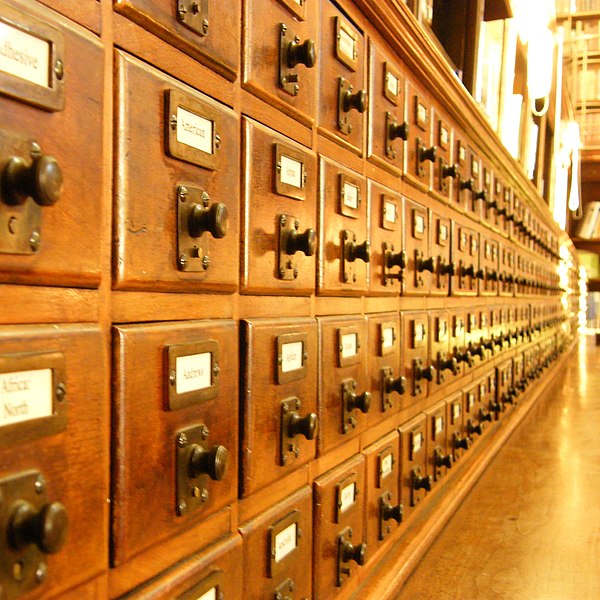
    Library card index
    Author Stuart Caie
    Source Wikipedia
    Creative Commons Licence


    On Monday 22 June 2015 I attended a reception at the British Library to celebrate the launch of a report by Adroit Economics entitled Enterprising Libraries: A blueprint for delivering economic growth in UK cities. According to Adroit Economics
    "Adroit evaluated the British Library's major business support programme which provides advice on IP and other business start-up and growth issues, serving c 2,200 start-ups."
    I have not yet been able to find a copy of the report but its highlights are summarized in an article in the British Library's Innovation and Enterprise blog on 23 June.

    Evidently the British Library were very pleased with the report for they threw quite a lavish party which included a private view of the Magna Carta: Law, Liberty, Legacy exhibition. There were speeches by Roly Keating, Chief Executive of the British Library, Darren Henley, Chief Executive of the Arts Council and Kanya King, founder and CEO of MOBO (Music of Black Origin). Unfortunately, the acoustics in the entrance hall to the British Library where the reception was held were appalling. I  could barely make out a word that any of them said. I could hear none of King's speech whatsoever because she spoke very softly even though I moved as close to the lectern as possible.

    There were also some of the great and the good of innovation at the reception:  Mandy Haberman, inventor of the Anywayup cup. Bola Olabisi founder of the Global Women Inventors and Innovators Network whom I featured in  Innovation in Africa - Bola Olabisi 5 March 2011 and the patent agent Richard Gallafent who founded Ideas 21. There were also friends and acquaintances from the Intellectual Property Office and PATLib libraries like Joyce Gray of Sheffield and Ruth Grodner of Liverpool though sadly neither Ged Doonan nor Stef Stephenson who had blazed a trail for libraries everywhere from Leeds were present. Instead, Leeds libraries were represented  by officials whom I had never met before in the decade that I have been running the Leeds Inventors Club and giving talks and dispensing free legal advice there.

    However, I made some new acquaintances in the PatLib network such as John Musham of Newcastle and a delightful pair from the magnificent Library of Birmingham  I commended the new library and the Hippodrome Theatre which I had visited two days earlier to celebrate the 25th anniversary of Sadler's Wells Royal Ballet's move to Birmingham and David Bintley's 20 years as artistic director of the company (see In Praise of Bintley 21 June 2015 Terpsichore). They were purring like kittens at the compliments to their city until I reminded them of the latest census returns which had put Greater Manchester marginally ahead of the West Midlands in the number of inhabitants (see Largest urban areas of the European Union Wikipedia) and muttered about the Northern Powerhouse. Cruel I know but as a Mancunian I am incensed by the notion that the city of Cobden, Rutherford and Turing yields to anyone. Now there is no longer even a statistical basis for the estwhile metal bashers to claim to be the UK's second city if indeed there ever was.

    I should say a few words about the Enterprising Libraries programme. This is a joint venture between the British Library and the Department for Communities funded by the Arts Council England to develop local libraries into community hubs for local economic growth. I have written extensively about this programme in this and my other blogs over the last few years and you will find links to my articles in PatLib Libraries in the UK 25 Jan 2015. To a very large extent this initiative compensates for the closure of the Business Link network  by the Coalition government. The first phase was to develop Birmingham, Leeds, Liverpool, Manchester, Newcastle and Sheffield libraries into local Business and IP Centres in partnership with the British Library (see the National Network page of the British Library's website). The Arts Council has just announced that 10 other library authorities in England have been awarded a share of a £450,000 grant to develop business and IP reference services (see the Successful applicants page of the Arts Council's website). Pilot schemes to develop Exeter and Northampton Central Libraries into Business and IP Centres.

    With 10 years experience of working with libraries in the North to holding clinics, running inventors clubs and speaking on intellectual property I see the value of this initiative and will support it in any way I can. Should anyone wish to discuss this they should call me on 020 7404 5252 during normal office house or contact me through this form.

    14 May 2015

    The Intellectual Property Office looks at Additive Manufacturing

    Turbine produced by 3D Printing
    Source Wikipedia


    I have written quite a lot about additive manufacturing including 3 dimensional printing over the last few years. You will find links to those articles at Liverpool Inventors Club Re-launch - Fabulous FabLab 28 Jan 2012. At the end of April 2015 the Intellectual Property Office published A Legal and Empirical Study into the Intellectual Property Implications of 3D Printing in the following parts:
    The IPO had commissioned the study because Andrew Sissons and Spencer Thompson had recommended a review of the intellectual property implications of 3D printing in their report Three Dimensional Policy Why Britain needs a policy framework for 3D printing which was published by the Big Innovation Centre in Oct 2012.

    Study 1 considered the legal framework in the UK and other countries and concluded that there was some uncertainty as to whether CAD files and their data could be protected adequately. Study 2 discussed additive manufacturing technologies and their application to date. The Studies concluded that from the data retrieved in Study I, there was nothing to indicate that the activity on 3D printing on-line platforms was a mass phenomenon yet. As such, there was no urgency to legislate on 3D printing. Indeed the report argued that
    "a premature call for legislative and judicial action in the realm of 3D printing could stifle the public interest of 'fostering creativity and innovation and the right of manufacturers and content creators to protect their livelihoods.'”
    Nevertheless, there was a need to clarify the law on  whether a CAD file is capable of copyright protection. It was thought that the territorial nature of copyright law, coupled with the extra territorial nature of on-line platforms and CAD files shared thereon, could lead to uncertainty and complex issues in the future. The Studies urged the IPO to
    "establish a Working Group to cover the various IP rights which may need to be tackled in the future. The Working Group should also provide clarity on the status of CAD files and how they can best be used in industry. The Group should also consider how best to tackle the traceability of 3D printed spare parts."
    In other words, pretty well much the same recommendation as Sisson and Thompson had made in their report nearly three years ago.

    I take issue with some of those conclusions. Additive manufacturing may not be a mass phenomenon in the sense that there is a 3D printer in every home or a 3D print shop on every street corner but those technologies are developing rapidly and are finding ever increasing uses ranging from the fabrication of prosthetic body parts and the reconstitution of human tissues to precision engineering. The industry may be in its infancy but it is already big and it is growing quickly. Secondly, Study I concentrated on copyright but not other intellectual property rights albeit that Study 2 considered them in the context of the case studies. I do not anticipate any difficulty over whether copyright subsists in CAD files but I do see increasing scope for arguments over obviousness in relation to inventions developed with CAD technology. Also, there is an clear risk of counterfeiting through the use of such technology. However, I would agree that there is no need for specific legislation at this stage if ever. The existing legislative framework and the courts should be able to cope with all  foreseeable problems.

    Should anyone wish to discuss these studies or the legal consequences of additive manufacturing technology in general, he or she should call me on 020 7404 5252 during office hours or send me a message through my contact form.

    14 March 2015

    Trade Marks for Inventors


    Jane Lambert


    Inventors are most interested in protecting their inventions for which they require patents but some set up businesses to manufacture or market their inventions. Such businesses need to identify themselves and their products in the market place and for that they need brands. Brands are built up by sales and marketing and the common or judge made law of England and Wales gives a measure of protection for established brands by the law of passing off, But if you are new to the market or are about to launch a new product or service you can't rely on that law. You need to register a trade mark first.

    What are trade marks?
    S.1 (1) of the Trade Marks Act 1994 defines a trade mark as
    "any sign capable of being represented graphically which is capable of distinguishing goods or services of one undertaking from those of other undertakings."
    The following paragraph helpfully adds:
    "A trade mark may, in particular, consist of words (including personal names), designs, letters, numerals or the shape of goods or their packaging."
    The Trade Marks Act 1994 applies only to the United Kingdom but our trade marks law has been harmonized for over 20 years with the laws of the rest of the European Union by an EU Directive and a string of decisions of the Court of Justice of the European Union. As all the EU member states are members of the World Trade Organization EU trade mark law and the trade mark laws of each of its member states have to comply with Annex 1C to the World Trade Organization Agreement which is better known as TRIPS (Trade-Related Aspects of Intellectual Property Rights). Art 15 (1) of TRIPS contains a definition that is very similar to s.1 (1) of our Trade Marks Act 1994.

    A word on spelling
    You will have noted that trade mark is spelt as two words in our statute but as one word in the TRIPs. Both spellings are correct but we tend to use the two word spelling in the UK, the EU and most of the Commonwealth whereas Americans use one word. As I am British I shall stick to spelling it as two words but you may find your spell check prefers the American spelling.

    Specified goods
    Trade marks are registered for goods or services and when you apply for a trade mark you have to specify the goods or services to which it is to apply.

    It is still sometimes possible for two different trade mark owners to register the same sign for different goods. We were once familiar with Mazda card and Mazda light bulbs. But that has become more difficult since s.5 (3) of the Trade Marks Act 1994 now provides that a trade mark shall not be registered if it is
    "identical with or similar to an earlier trade mark, shall not be registered if, or to the extent that, the earlier trade mark has a reputation in the United Kingdom (or, in the case of a Community trade mark or international trade mark (EC) in the European Community) and the use of the later mark without due cause would take unfair advantage of, or be detrimental to, the distinctive character or the repute of the earlier trade mark."
    Goods and services are divided into a number of classes by an international agreement called the Nice Agreement Concerning the International Classification of Goods and Services for the Purposes of the Registration of Marks or Nice Agreement for short.  Our Intellectual Property Office has very helpfully published Guidance Trade mark classification list of goods and services 2 May 2014 which you can consult on its website.

    When you apply to register a trade mark you have to state the class or classes of goods and services for which you wish the mark to be registered. You should bear in mind that one class of goods or services is included in your application fee and that you have to pay extra for each additional class of goods or services.

    What is the point of a trade mark?
    The rights conferred by the registration of a trade mark are set out most succinctly in art 16 (1) of TRIPS:
    "The owner of a registered trademark shall have the exclusive right to prevent all third parties not having the owner’s consent from using in the course of trade identical or similar signs for goods or services which are identical or similar to those in respect of which the trademark is registered where such use would result in a likelihood of confusion. In case of the use of an identical sign for identical goods or services, a likelihood of confusion shall be presumed"
    That is echoed by s.9 (1) of our Trade Marks Act 1994:
    "The proprietor of a registered trade mark has exclusive rights in the trade mark which are infringed by use of the trade mark in the United Kingdom without his consent."
    The acts that constitute infringement are set out at some length in the first three sub-sections of s.10 of the 1994 Act.

    UK and Community Trade Marks
    Applicants for trade marks in the UK has the choice of registering a trade mark for the UK alone or for the whole of the EU. Trade marks for the whole EU are known as "Community trade marks" or "CTM" and I shall refer to them as CTM for the rest of this article.

    If you want a trade mark for the UK alone you apply to the Intellectual Property Office or "IPO" in Newport. The department that looks after trade marks is known as the Trade Marks Registry which us usually referred to as "the Registry".  Confusingly the head of the IPO is called "the Comptroller" in relation to patents and unregistered design rights but "the Registrar" in relation to trade marks and registered designs, However, he or she is the same person.

    If you want a CTM you have to apply to the curiously named Office for Harmonization in the Internal Market Trade Marks and Designs ("OHIM") in Alicante in Spain. Applications for CTM are governed by the CTM Regulation (Council Regulation (EC) No 207/2009 of 26 February 2009 on the Community trade mark OJ 24.3.2009 L78/1) but its provisions are very similar to those of the Directive and hence our Trade Marks Act 1994.

    Guidance on applying for trade marks
    The IPO contains a useful step by step guide to registering a UK trade mark that begins with the section "Trade marks: protect your brand". The next sections are "What you can and can't register", "Apply" and "After you apply". Most of the information in those pages would also be of use if you are applying for a CTM or a trade mark in any other country's trade marks registry.

    If you want a CTM, OHIM also gives you some useful information. I recommend starting at the Trade Marks Basics page and working your way from there. There is an amusing little animated video called "It's all about trade marks" which you shouldn't miss.

    There is also useful stuff on the British Library's Business and IP and World Intellectual Property Office websites and there is lots more from law firms, patent offices, trade mark and patent agencies and universities around the world but for now I would be content with the publications that the IPO and OHIM put out otherwise you will never get started.

    Should you get professional advice?
    It is perfectly possible for a reasonably well educated and intelligent individual to apply for a UK trade mark or CTM without the assistance of a trade mark or patent attorney or lawyer and many business owners do just that but unless you have a lot of experience of IP and trade marks you can easily come unstuck if you try to do it yourself. For instance, you may miss something on a search, you may fill out the form incorrectly, you may apply for a mark that can't be registered or a third party may oppose your mark after it has been advertised if he thinks that you are unrepresented in circumstances that he wouldn't try if he knew you were professionally represented. The cheapest you can register a UK mark is £170 if you make the application on-line and there are many attorneys who will do all the searches, draft the application, pay the Registry fees for £500 or less. To me that seems a no-brainer.

    If you don't have an attorney and you would like me to suggest one, call me on 020 7404 5252 during normal office hours or message me through my contact form.

    On-line or paper
    Both the IPO and OHIM encourage on-line applications by offering slight discounts for on-line applications.

    Searches
    Regardless of whether you apply for a UK mark or a CTM it is imperative that you carry out a thorough search for you will probably not be allowed to register a mark that is the same or similar to an existing one for the same or similar goods or services. Even if your application does somehow slip through the owner of the earlier mark can apply to invalidate it on the grounds that it should never have been registered.

    You can search the IPO or OHIM databases yourself (see Search for a Trade Mark on the IPO website and eSearch plus on OHIM's) but you will get a better result if you instruct an attorney for he or she knows what to look for. You can also get a good search from Leeds Business and IP Centre if you call Ged or Steff on 0113 247 8266.

    Making the application
    As there is excellent information from the IPO and OHIM on trade mark applications I am not going to repeat it here.

    If you are doing it yourself and encounter a problem you can contact me on 020 7404 5252 or use my contact form. In most cases my advice will be go find an attorney and I will tell you how to get one but there may be a point of law which requires professional advice in which case I will see you in conference or advise you in writing (see "What happens if the examiner says no?" below).

    IP insurance
    Another thing you should consider when you apply for a trade mark is enforcement. Although some trade mark infringements are crimes which can be prosecuted by trading standards officers in the magistrates or Crown Court it is generally down to you to enforce your trade mark. You do that by issuing proceedings in the civil courts. Though you can't start proceedings until your mark has been registered your rights and hence your claim to damages can be backdated to the date of application. IP litigation in the UK has always been more expensive than on the Continent and the costs of issuing proceedings for claims over £10,000 have recently sky rocketed (see How to enforce your IP claim after court fees sky rocket 7 March 2015). Unless you have lots of money I would advise your taking out before-the-event IP insurance at the earliest possible opportunity (see Intellectual Property Litigation - the Funding Options 10 April 2013 NIPC Law) which is when in the case of trade marks is when you make your application.

    What if the examiner says no?
    Here's where I come in. Any decision of the hearing officer can be appealed but appeals are be expensive and you will want to make sure that you are on firm ground. You could ask your trade mark or patent attorney or your solicitor but at the end of the day they may well suggest your taking counsel's opinion. "Counsel" is another word for barrister or someone like me and if you want to know what IP barristers such as I can offer read my article IP Services from Barristers 6 April 2013 4-5 IP). I will advise you on your options and if you decide to appeal I will represent you all for a fixed fee that will be agreed in advance. Again, if you want to consult me call me on 020 7404 5252 during normal office hours or message me through my contact form.

    In the IPO appeals from examiners are made to an official known  as a hearing officer who sits on behalf of the Registrar. The IPO has published two useful articles on Options following an objection to a trade mark examination and Trade mark disputes resolution: hearings which I advise you to read.

    Appeals in OHIM are made to Boards of Appeal and the procedure is set out in the Appeal page.

    What if someone else says no?
    if the examiner finds no objection  to your application it will be advertised on the web and elsewhere. If anyone objects to your application he or she may get a trade mark or patent attorney to write to you to explain the objection and ask you to withdraw your application.  Again, this is where I could come in either at your request or the request of your attorneys or lawyers. I can advise you whether the objection is justified and if it is not represent you in opposition proceedings again for an agreed fee.

    There are basically two grounds upon which an opponent can object to your application. The first is that he or she has an earlier trade mark with which your mark conflicts. The second is that he or she could bring an action for passing off, copyright infringement or some other cause of action that would prevent your using your mark.

    Appeals in the IPO are heard by hearing officers and appeals in OHIM by Boards of Appeal, Much of what I have written under the previous heading applies to opposition proceedings.

    Registration
    If nobody objects to your application or if all objections are resolved in your favour your application will proceed to grant and you will receive a certificate of registration and your mark will be entered on the register.  However, that is not necessarily the end of the story because it is still open to a third party to apply for invalidation of your mark on the ground that it should never have been granted. You also have to make sure that you use your mark within 5 years of registration otherwise someone may seek its revocation for non-use. Invalidity proceedings can be made in the Trade Marks Registry or as the case may be OHIM or by way of counterclaim in any proceedings you may bring for infringement of its mark.

    Watch service
    You need to make sure that another business does not apply to register the same or similar mark for the same or similar goods. As it is impractical for most businesses to scour the intellectual property offices or trade mark journals it is a good idea to instruct someone to do that for you. That is known as a "watch service". Your attorney ought to be able to arrange that for you but if not call Ged or Steff at Leeds Business and IP Centre on 0113 247 8266.

    If you want to discuss this article or trade marks generally call me on 020 7404 5252 or use my contact form.